Initial notification.
An affected source must file an Initial Notification and a Notification of Compliance Status. A new source has 180 days from startup to notify; relocations and changes of ownership can start the clock again.
EPA's 6H rule — 40 CFR Part 63, Subpart HHHHHH — governs every collision center and dealer body shop that sprays coatings containing the target metal HAP. A plain-English breakdown of what the rule requires, and the records an inspector will ask to see.
Subpart HHHHHH is an area-source standard, which is exactly why it catches collision centers off guard¹ — it reaches the small shop, not just the major emitter. Compliance is not a single inspection you pass; it is a standing record: certified painters, compliant guns, a filtered booth, an enclosed gun cleaner, and the documentation that proves all four². The shops that pass an inspection are the ones holding that record before the regulator calls.
Compounds of Cr · Pb · Mn · Ni · Cd — defined at 40 CFR 63.11175. If a coating you spray-apply contains any one of them, your shop is an affected source.
Transfer efficiency is the share of sprayed coating that actually lands on the part rather than drifting into the booth as overspray. The rule sets a floor of 65 percent, which is why conventional high-pressure guns are out and HVLP, electrostatic, and airless systems are in.
The rule pairs a 65 percent transfer-efficiency floor at the gun with a 98 percent overspray-capture floor at the booth — both have to be demonstrable, not merely installed.
An affected source must file an Initial Notification and a Notification of Compliance Status. A new source has 180 days from startup to notify; relocations and changes of ownership can start the clock again.
Anyone who spray-applies a coating containing target HAP must be trained in proper technique and in the requirements of the rule — with the training renewed every five years.
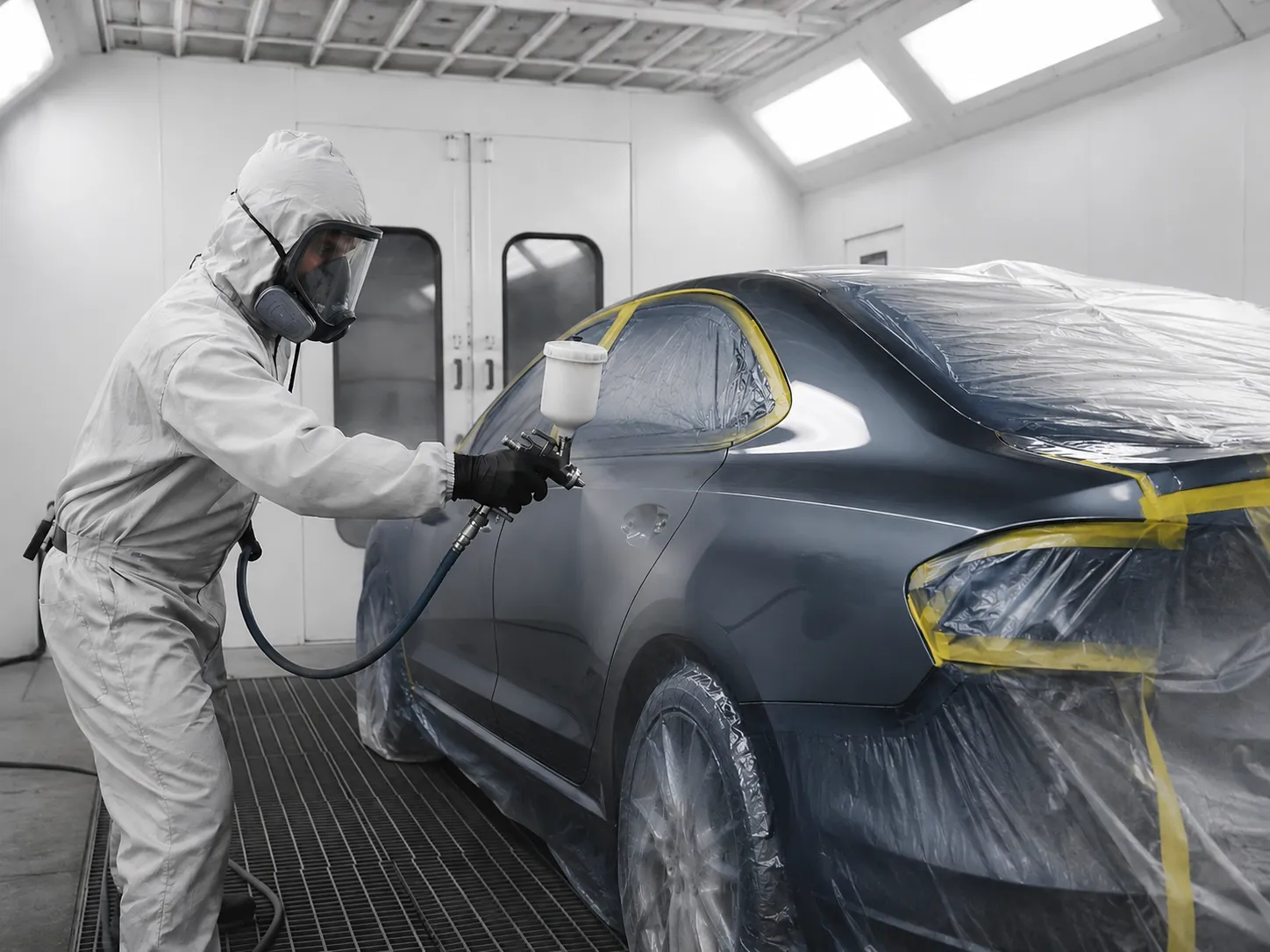
Coatings must be applied in a full booth, prep station, or mobile enclosure using filter technology demonstrated to capture at least 98 percent of overspray — or a waterwash booth.
Coatings must be applied with HVLP, electrostatic, airless, air-assisted airless, or an EPA-approved equivalent at no less than 65 percent transfer efficiency. Conventional high-pressure guns do not qualify.
Spray-gun cleaning must be performed so that cleaning solvent is not atomized or otherwise released to the shop air — an enclosed system, or an equivalent non-atomizing method.
Training certifications, documentation of compliant equipment and booth filters, and the gun-cleaning practice must be retained for five years and made available to the regulator on request.
"A 6H citation is rarely about the equipment in the booth. It is about the paperwork that proves the equipment. The record has to exist before the inspector asks for it."
Automotive Risk Management Partners (ARMP) is an all-in-one dealership compliance and cyber-security platform for franchise dealers, collision centers, RV dealers, and multi-rooftop groups. EPA's 6H rule is one line on a long list — OSHA, EPA, the FTC Safeguards Rule, F&I, and data security all sit on the same desk. We help you cover the whole list, across every rooftop, with the records ready before anyone asks for them.
If you spray-apply coatings that contain any of the target HAP — chromium, lead, manganese, nickel, or cadmium compounds, which appear in most refinish primers, basecoats, and hardeners — then yes, your shop is an affected source under 40 CFR Part 63 Subpart HHHHHH. Shops that strip paint with methylene chloride are also covered. Even a shop that believes it is not subject is expected to document that determination.
Subpart HHHHHH regulates compounds of five metals: chromium (Cr), lead (Pb), manganese (Mn), nickel (Ni), and cadmium (Cd). The rule focuses on the spray application of coatings that contain these metals because the overspray carries them into the air. Whether the rule applies to your shop comes down to what is in the coatings you actually spray, which the SDS for each product will tell you.
Yes. 40 CFR 63.11173(e) requires that anyone who spray-applies coatings be trained in spray technique and the requirements of the rule, with the training renewed every five years. The certification has to be documented and kept current for every technician who sprays — not just the lead painter.
Coatings must be applied with high-volume low-pressure (HVLP), electrostatic, airless, air-assisted airless, or an EPA-approved equivalent achieving at least 65 percent transfer efficiency. Conventional high-pressure guns do not qualify. It is worth confirming the technology class of every gun on the floor, not only the newest one.
You keep the painter training certifications, documentation of compliant spray equipment and booth filters, and the gun-cleaning practice — retained for five years and made available to the regulator on request, per 40 CFR 63.11174(b). Keeping them in one place, rather than scattered across binders and inboxes, is what makes an inspection short.
The federal rule centers on the Initial Notification, the Notification of Compliance Status, and ongoing recordkeeping rather than a routine annual federal report. However, many states and local air districts administer 6H under a delegated program and expect a periodic self-certification. The sample on this page is a starting point; confirm the exact form your jurisdiction requires.
Paint stripping with methylene chloride is the other half of Subpart HHHHHH. You must minimize stripper evaporation and, above the annual usage threshold, maintain a written management plan to reduce emissions — kept alongside your coating records.
We help franchise dealers and collision centers stay ahead of OSHA, EPA, and state compliance — 6H included.